Thursday, August 29, 2013

Oedipus and my Big Question

My Big Question simply states: "How do people recover when faced with adversity?"  After reading Oedipus, I realized that my question does not necessarily fit with the reading, seeing as Oedipus does not necessarily recover once he is faced with difficulty, but instead I came up with a new question to apply to Oedipus Rex.  How does Oedipus respond to the challenges that he faces and what does this say about him?

Oedipus wants to avenge the king's death, but he does not know who killed the king because he did not live in the kingdom when the king was killed. Oedipus goes on this journey to find the killer, when really he is the killer the whole time, he is just unaware of the fact. When Oedipus finds out that he is the one who murdered the king, he also learns that the oracle that was told about his life did in fact come true.  Oedipus is faced with a situation where he feels uncomfortable and does not know what to do.  He wants to avenge the king's death, but he does want to take his own life.  He is faced with a trial and he does not know how to overcome and recover from it.  Instead of looking at things in a logical manner, Oedipus decides that he should not be allowed to see, because he deserves to be punished for the wrongful things he did.  Instead of choosing to overcome his hardships, Oedipus succumbs to the idea of losing his eyesight because he believes he will never be able to learn from what he has done wrong, and must therefore be reminded by it constantly.  Oedipus chooses to do the opposite of what my question and thinking imply.  He does not want to move on from what he has done wrong, but instead wants to wallow in his punishment.  Essentially, he chooses to be unhappy for the rest of his life because that is the only way he knows how to let go of his problems.  Through this difficulty and hardship, Oedipus becomes a man of little determination, who only wants to gauge out his eyes in order to pay for the crimes he has already committed, rather than to try to overcome his challenges.  He took the easy, less complicated way of getting rid of the pain, instead of pushing himself to become a better version of himself.  Oedipus chose to go against my Big Question and not to persevere when the hard things get in the way, making his life easier in the long run, but more painful down the road.


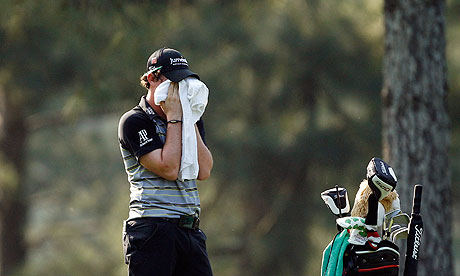
What Rory Taught Me

"Fore!"  the caddy yelled out, as Rory McIlroy teed off on the final hole of his very first Masters Tournament.  Rory had been ahead since the first round, and was in the lead by four strokes at the end of the third round the day prior.  The final day, Sunday, had been a different story, though.  He had started off well, but not as good as the days before.  He was still in the lead after the front nine holes, but the nerves had gotten to him, and soon he was behind the leader by ten strokes, with only the last hole to go.  There was no way he was going to be able to regain the lead.  He was so close to perfection, and yet he had let it slip through his hands.  That weekend, the entire world knew who Rory McIlroy was and watched his mental breakdown unfold on the golf course in Augusta.  Many believed that was the end of Rory McIlroy.  They thought he was a 'choker' and he could not finish well when the pressure was on.  But today was a different day.  It had been two months since that fateful day in Georgia, and now Rory was back in the same position.  He had the lead going into the final round at another major golf tournament, the U.S. Open.  He knew that today would have a different outcome though.  He was not going to let the pressure get to him, but instead play the game the way he knew he could.
Rory McIlroy at the 2011 Masters

Every year on my birthday my dad would talk about how he was watching Tiger Woods win his first Masters tournament while I was being born.  Growing up, I thought, hmm, that's interesting, but I don't really care.  I was never into golf, nor did I care about who won the Masters the year I was born.  It didn't seem all that important to me.  Golf was something I watched at my grandparent's house when I wanted to take a nap.  Not a competitive sport that people could get into.  On my birthday in 2011 though, my opinion on golf changed.  I watched Rory McIlroy play his final round of the Masters, and watched him fail miserably.  He caught my attention, and for some reason, I couldn't turn away.  Even after the tournament was over, I continued to follow Rory's career and how he was doing throughout the season.  When it was time for the U.S. Open, I was scared that he would lose confidence again and lose this tournament as badly as he had lost the Masters.  Rory proved me wrong that day.  He ended up blowing away his competition with a lead of eight strokes over second place.  Not only was I hooked on golf from that day forward, but I also saw how people recover when they are faced with adversity.  Rory decided that he was not going to give up that day on the golf course, even though he knew most people thought he would fail.  He chose to overcome his problem, rather than let it control him and his thoughts.  Rory was able to work through his situation, and he became a better golfer because of it.  What Rory learned is not only applicable to golf, but also to life.  It's not about the difficulties that life hands us, but instead how we choose to overcome them.  And that defines who we are as people.


Rory McIlroy at the 2011 US Open